Transformation of UML connectors
In this section are specified transformation rules for UML association, generalisation and dependency connectors. Table 1 provides an overview of the section coverage.
| UML element | Rules in core ontology layer | Rules in data shape layer | Rules in reasoning layer | Rules in JSON-LD context layer |
|---|---|---|---|---|
Association |
||||
Association domain |
||||
Association range |
||||
Association multiplicity |
||||
Association asymmetry |
||||
Association inverse |
||||
Dependency |
||||
Dependency domain |
||||
Dependency range |
||||
Dependency multiplicity |
||||
Class generalisation |
||||
Property generalisation |
||||
Class equivalence |
||||
Property equivalence |
||||
Realisation |
Unidirectional association
A binary Association specifies a semantic relationship between two member ends represented by properties. Please note that in accordance with specification [uml2.5], the association end names are not obligatory. However, we adhere to the UML conventions , where specification of at one member ends, for unidirectional association, and two member ends, for bidirectional association, is mandatory. Moreover, provision of a connector (general) name is discouraged.
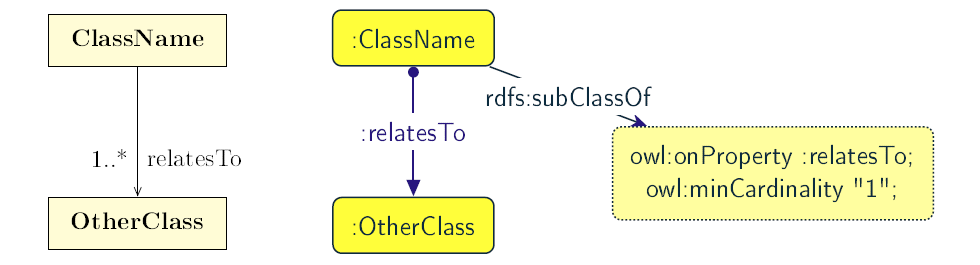
Specify object property declaration axiom for the target end of the association/dependency.
| Ideally, in the implementation, this rule would be combined with the relevant rules (those for the core ontology layer) in the Transformation of UML descriptors section, to provide labels and documentation for the property at the time of its creation. |
Listing 1. Property declaration in Turtle syntax
|
Listing 2. Property declaration in RDF/XML syntax
|
Specify PropertyShape declaration axiom for each association/dependency.
| Ideally, in the implementation, this rule would be combined with the relevant rules (those for the data shape layer) in the Transformation of UML descriptors section, to provide labels and documentation for the property shape at the time of its creation. |
| For handling bidirectional associations refer to the Bidirectional association section. |
Listing 3. PropertyShape declaration for associations in Turtle syntax
|
Listing 4. PropertyShape declaration for associations in RDF/XML syntax
|
For each UML association/dependency, specify an object property by creating a property URI mapping with an absolute URI of a target end in a node object. Set the term definition as a top-level entry inside the class’s inner context object. For bidirectional connectors, additionally specify an extended term definition for the source end.
Listing 5. Association/dependency term mapping in JSON-LD syntax
|
Association source
Specify object property domain for the target end of the association/dependency.
Listing 6. Domain specification in Turtle syntax
|
Listing 7. Domain specification in RDF/XML syntax
|
Listing 8. Object property domain specification for reused relations in Turtle syntax
|
Listing 9. Object property domain specification for reused relations in RDF/XML syntax
|
Association target
Specify object property range for the target end of the association.
Listing 10. Range specification in Turtle syntax
|
Listing 11. Range specification in RDF/XML syntax
|
Listing 12. Object property range specification for reused relations in Turtle syntax
|
Listing 13. Object property range specification for reused relations in RDF/XML syntax
|
Within the SHACL PropertyShape corresponding to an association relation linked to a given source UML Class, specify property constraints indicating the range class.
Listing 14. Property class constraint in Turtle syntax
|
Listing 15. Property class constraint in RDF/XML syntax
|
For each UML association/dependency, specify the object property range by creating a type coercion entry in a node object. Set the fixed @id keyword as a value to indicate that that the value of the term should be interpreted as an URI. Set the term definition as a top-level entry inside the class’s inner context object. For bidirectional connectors, additionally specify the object property range for the source end.
Listing 16. Type coercion for association & dependency in JSON-LD syntax
|
Association multiplicity
For the association/dependency target multiplicity, where min and max are different than ``*'' (any) and multiplicity is not [1..1], specify a subclass axiom where the source class specialises an anonymous restriction of properties formulated according to cases provided by rule:attribute-rc-multiplicity. For dependency relations, the property range is always defined as skos:Concept.
Listing 17. Min cardinality restriction for association in Turtle syntax
|
Listing 18. Min cardinality restriction for association in RDF/XML syntax
|
Listing 19. Min cardinality restriction for dependency in Turtle syntax
|
Listing 20. Min cardinality restriction for dependency in RDF/XML syntax
|
If the association/dependency multiplicity is exactly one, i.e. [1..1], specify a functional property axiom like in rule:attribute-rc-multiplicity-one.
Listing 21. Declaring a functional property in Turtle syntax
|
Listing 22. Declaring a functional property in RDF/XML syntax
|
Within the SHACL PropertyShape corresponding to an association/dependency relation linked to a given source UML Class, specify property constraints indicating minimum and maximum cardinality, according to cases provided by rule:attribute-ds-multiplicity.
Listing 23. Min cardinality constraint in Turtle syntax
|
Listing 24. Min cardinality constraint in RDF/XML syntax
|
Specify a default container type for each UML association/dependency that can accept more than a one value by setting the fixed @set keyword as a value for the @container key.
Set the container type entry for an association/dependency target end, inside a term definition created as a top-level entry inside the class’s inner context object. For bidirectional connectors, additionally specify the container type for the source end.
Listing 25. Association & dependency container definition in JSON-LD syntax
|
Recursive association
In case of recursive associations, that are from one class to itself, (depicted in Figure 2), the transformation rules must be applied as in the case of regular unidirectional association, which are from Rule R.01 to Rule R.09. In addition, the association must be marked as asymmetric expressed in Rule R.13 and Rule R.12.
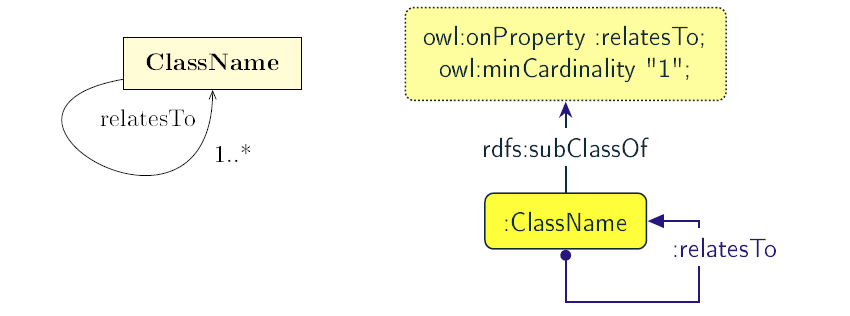
Specify an asymmetric object property axiom for each end of a recursive association.
Listing 26. Declaring an asymmetric property in Turtle syntax
|
Listing 27. Declaring an asymmetric property in RDF/XML syntax
|
Within the SHACL Node Shape corresponding to the UML Class, specify SPARQL constraint selecting instances connected by the object property in a reciprocal manner.
Listing 28. Adding details to a NodeShape for an asymmetric property in Turtle syntax
|
Listing 29. Adding details to a NodeShape for an asymmetric property in RDF/XML syntax
|
Bidirectional association
The bidirectional associations should be treated, both on source and target ends, like two unidirectional associations (see Figure 3). The transformation rules from Rule R.01 and Rule R.02, and all the other rules for unidirectional associations shown in Table 1 must be applied to both ends. In addition to those rules, the inverse relation axiom must be specified.
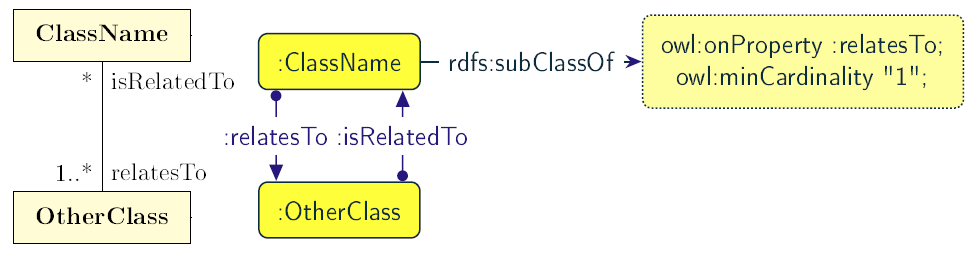
Specify an inverse object property axiom between the source and target ends of the bidirectional association.
Listing 30. Declaring an inverse property in Turtle syntax
|
Listing 31. Declaring an inverse property in RDF/XML syntax
|
Unidirectional dependency
In general the UML dependency connectors should be transformed by the rules specified for UML association connectors (see Table 1).
The following two rules, concerning the transformation of dependency targets, are different from the rules for the transformation of association targets.
Specify object property range for the target end of the dependency.
Listing 32. Range specification in Turtle syntax
|
Listing 33. Range specification in RDF/XML syntax
|
In OWL we want to state only that the range of a Dependency connector is a skos:Concept, without committing to a specific list. We do this additional restriction in the data shape.
|
Within the SHACL PropertyShape corresponding to a dependency relation linked to a given source UML Class, constraint the range of the dependency.
Specify the suitable constraint based on the constraint level set for the UML Enumeration (as defined in rule:enumeration-constraint-level):
-
permissive: set
skos:Conceptas the expected type of an enumeration item -
restrictive: refer to a NodeShape for an enumeration item that further restricts allowed values (see the transformation rule for enumeration item).
Listing 34. Permissive shape in Turtle syntax
|
Listing 35. Permissive shape in RDF/XML syntax
|
Listing 36. Restrictive shape in Turtle syntax
|
Listing 37. Restrictive shape in RDF/XML syntax
|
Class generalisation
Generalisation [uml2.5] defines specialization relationship between Classifiers. In case of UML Classes it relates a more specific Class to a more general Class.
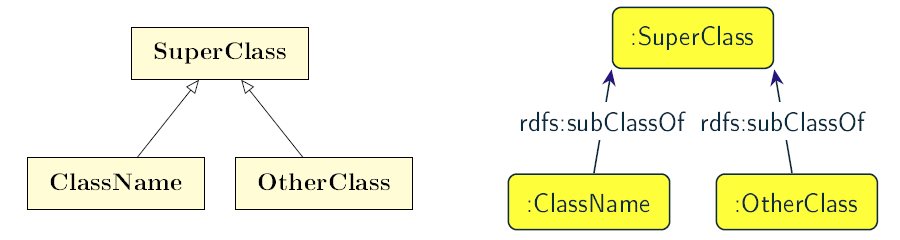
A UML generalisation set [uml2.5] groups generalisations. Subclasses in a generalization set are, by default, incomplete and can overlap. Generalization set properties are not supported.
Specify subclass axiom for the generalisation between UML Classes.
Listing 38. Subclass declaration in Turtle syntax
|
Listing 39. Subclass declaration in RDF/XML syntax
|
Property generalisation
Generalisation [uml2.5] defines specialization relationship between Classifiers. In case of the UML associations it relates a more specific Association to more general Association.
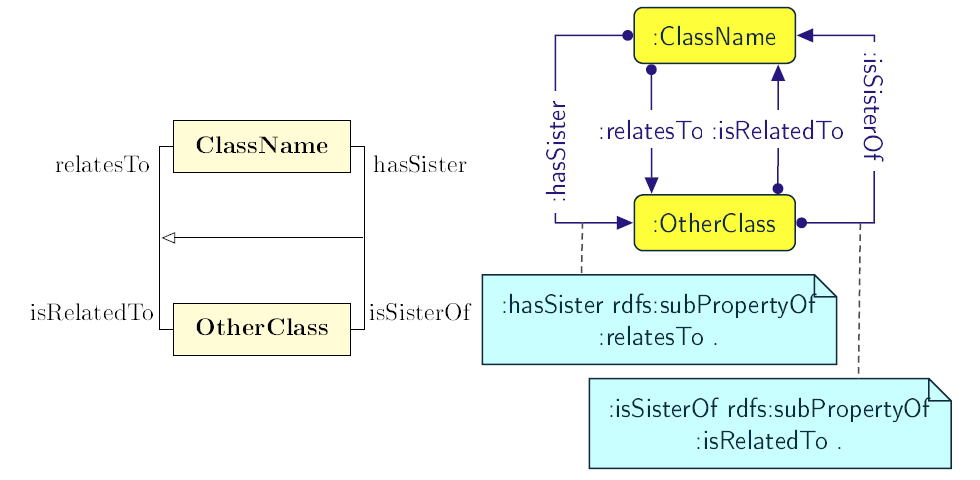
Specify a sub-property axiom representing the generalisation between named roles of UML associations. Properties on the subject and object positions correspond to the association roles belonging to the same side of the association ends. Such a sub-property axiom is specified for the target side of association ends (for unidirectional associations) or for both source and target sides of the association ends (for bidirectional associations).
Listing 40. Property specialisation in Turtle syntax
|
Listing 41. Property specialisation in RDF/XML syntax
|
Class equivalence
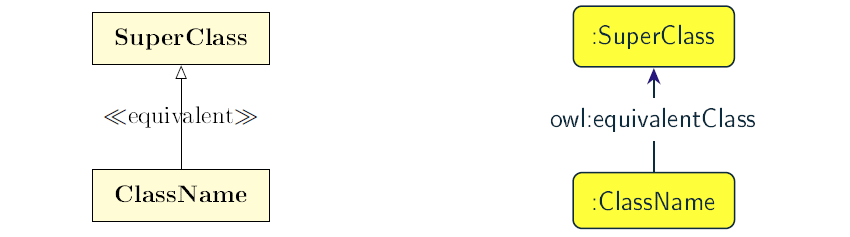
Specify equivalent class axiom for the generalisation with <<equivalent>> or <<complete>> stereotype between UML Classes.
Listing 42. Class equivalence in Turtle syntax
|
Listing 43. Class equivalence in RDF/XML syntax
|
Property equivalence
Specify equivalent property axiom for the generalisation with <<equivalent>> or <<complete>> stereotype between UML properties.
Listing 44. Property equivalence in Turtle syntax
|
Listing 45. Property equivalence in RDF/XML syntax
|
Realisation relations
Realisation defines a relationship between an Object element and a UML Class or Enumeration element. At the moment we only provide transformation rules for UML Realization connectors that connect to UML Classes.
Declare an individual with a specified class as its type, for a UML Realization connector between a UML Object and a UML Class.
Listing 46. Individual declaration in Turtle syntax
|
Listing 47. Individual declaration in RDF/XML syntax
|